

Picking the wrong AC size is one of the most expensive mistakes a homeowner can make. A unit that’s too small will run nonstop and never cool your home properly, while one that’s too big will short-cycle, waste energy, and leave you with sticky humidity, a real problem here in Southwest Florida. So if you’re asking “what size AC unit do I need for my house,” you’re already asking the right question.
The answer depends on more than just square footage. BTU ratings, tonnage, ceiling height, insulation, and even your home’s sun exposure all play a role in finding the right fit. Getting this calculation wrong means higher utility bills, more frequent repairs, and a system that wears out years before it should.
At Air Necessity, our non-commissioned technicians help homeowners across Cape Coral, Fort Myers, Naples, and the surrounding areas choose the right cooling system based on honest assessments, not sales quotas. This guide breaks down the BTU and tonnage calculations you need, gives you practical sizing charts, and explains the factors that affect cooling demand in our Southwest Florida climate so you can make a confident, informed decision.
How AC sizing works in Southwest Florida
AC sizing uses two measurements: BTUs (British Thermal Units) and tons. One ton of cooling equals 12,000 BTUs per hour, and residential systems typically range from 1.5 to 5 tons. In Southwest Florida, the baseline rules that work in cooler climates need significant adjustments because of the region’s extreme heat and sustained humidity levels throughout the year.
In Southwest Florida, year-round heat combined with humidity regularly above 70 percent means your AC works harder than a same-sized system would anywhere else in the country.
Why Florida’s climate changes the calculation
Most generic sizing guides assume moderate temperatures and average humidity. Southwest Florida averages daily highs above 90°F for months at a stretch, with humidity regularly pushing 75 to 85 percent. That means your system has to remove both heat and moisture simultaneously, which places significantly more demand on your equipment than a simple square footage chart can capture.
Your home’s orientation matters here too. A west-facing home in Cape Coral absorbs considerably more solar heat gain during afternoon hours than a north-facing home of identical square footage. That added heat load directly affects what size system your home actually needs, and it is one of the first variables a quality technician will consider before recommending equipment.
BTUs and tons: what the numbers mean
When contractors talk about capacity, they use tons as shorthand. A 3-ton unit moves 36,000 BTUs of heat out of your home every hour. For Florida homes, a practical starting point is roughly 400 to 600 square feet per ton, though the real number for your home will shift based on the adjustments covered in the steps below.
Understanding this matters because manufacturers and contractors use both units interchangeably. When you search for what size AC unit do I need for my house, knowing that a 2.5-ton system equals 30,000 BTUs helps you read spec sheets and compare contractor quotes without confusion. The following steps walk you through the full calculation so you end up with a number built around your specific home, not a national average.
Step 1. Measure the space you will cool
Before you can answer what size ac unit do i need for my house, you need accurate square footage. Most homeowners rely on their property listing or tax records, but those numbers often include garages, covered porches, and unfinished areas that your AC does not actually condition. Start from scratch with a tape measure.
How to measure each room
Walk through every room your system will cool and measure the length and width of each space. Multiply those two numbers to get the square footage for that room, then add every room together for a running total. For rooms with irregular shapes, break them into rectangular sections, calculate each section separately, and combine them.
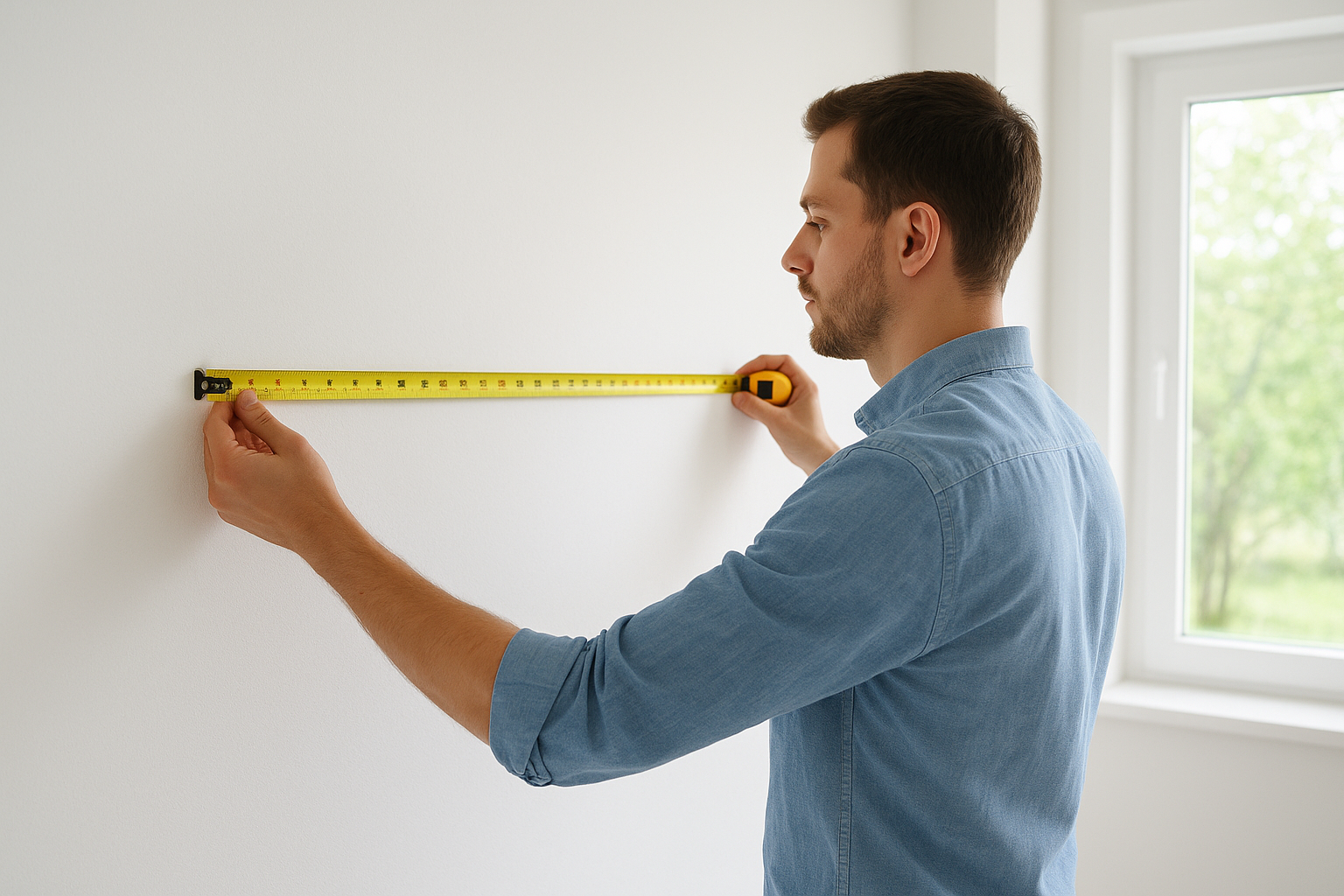
Measure twice and write it down as you go; a small error in one room compounds across the whole house and throws off your entire sizing estimate.
Use this simple tracking template:
| Room | Length (ft) | Width (ft) | Square Footage |
|---|---|---|---|
| Living Room | |||
| Primary Bedroom | |||
| Kitchen | |||
| Bedroom 2 | |||
| Bedroom 3 | |||
| Total | Add all rows |
What to leave out
Attached garages and screened lanais are almost never part of your conditioned square footage, even if they connect directly to your home. Including them will push your estimate high and steer you toward a larger unit than your house actually needs. Only count rooms with closed walls and ceilings that your AC system directly serves.
Step 2. Get a BTU and ton estimate from size
Once you have your conditioned square footage, you can run a baseline estimate using a standard BTU and ton chart. Keep in mind that this number is a starting point, not a final answer. Florida’s climate will push your real requirement higher, but the chart below gives you a frame of reference before you apply any adjustments.
The baseline sizing chart
Use this table to match your home’s square footage to a starting BTU range and ton equivalent. These figures follow the general industry standard before any climate or building factors are applied.
| Conditioned Square Footage | BTU Range | Estimated Tons |
|---|---|---|
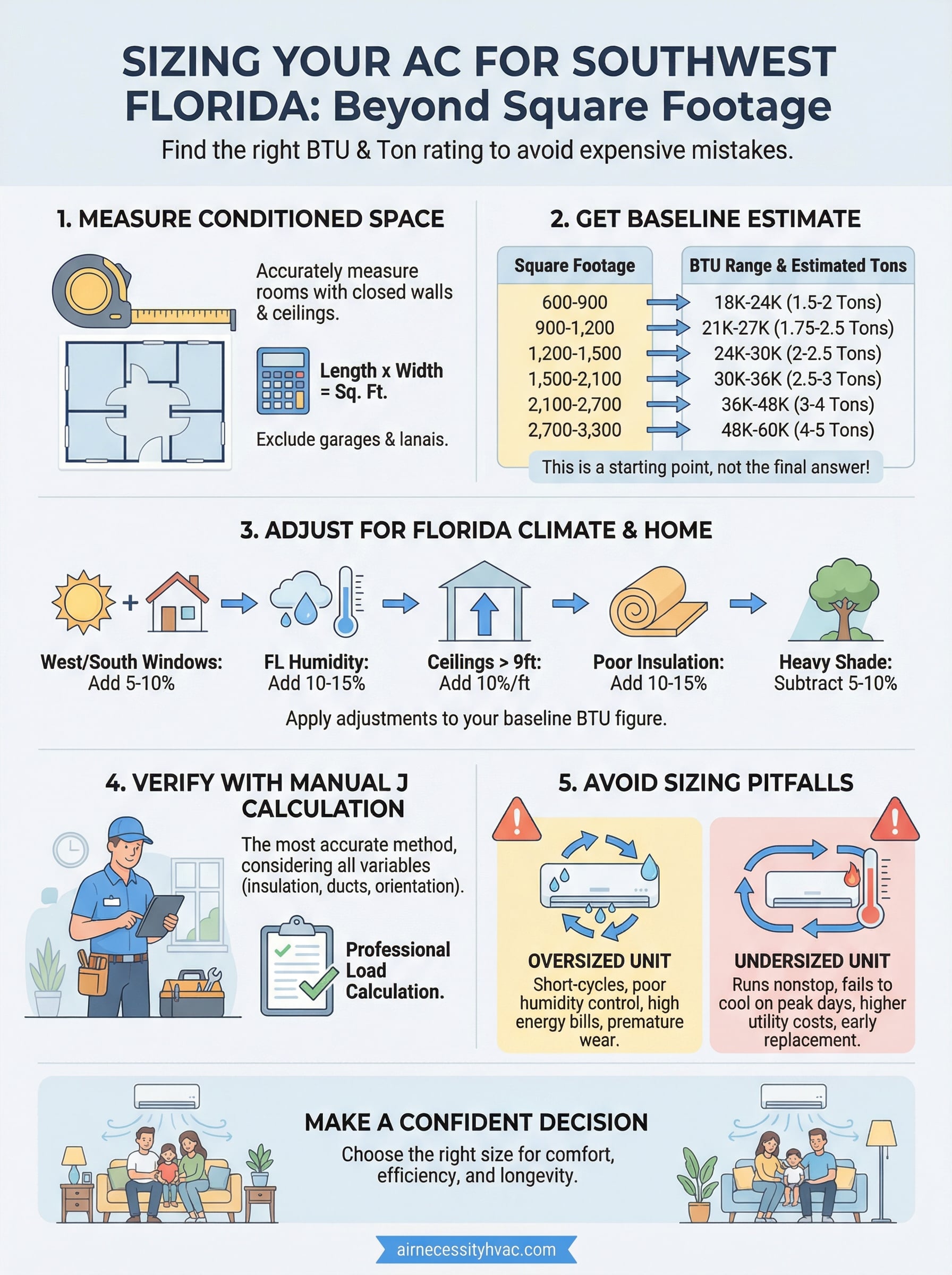
| 600 – 900 sq ft | 18,000 – 24,000 | 1.5 – 2 tons |
| 900 – 1,200 sq ft | 21,000 – 27,000 | 1.75 – 2.5 tons |
| 1,200 – 1,500 sq ft | 24,000 – 30,000 | 2 – 2.5 tons |
| 1,500 – 2,100 sq ft | 30,000 – 36,000 | 2.5 – 3 tons |
| 2,100 – 2,700 sq ft | 36,000 – 48,000 | 3 – 4 tons |
| 2,700 – 3,300 sq ft | 48,000 – 60,000 | 4 – 5 tons |
How to read your estimate
Find your square footage in the left column and read across to get your baseline BTU range and ton equivalent. If your home sits between two rows, use the higher range as your starting point. When you ask what size ac unit do i need for my house, this chart gives you an honest first number to bring into the next steps.
Treat this estimate as a floor, not a ceiling; Southwest Florida conditions will almost always push your final requirement above the baseline figure shown here.
Step 3. Adjust for humidity, sun, and home details
Your baseline estimate from Step 2 is a national average. Southwest Florida’s climate and your home’s specific features can push the real number up significantly, and skipping these adjustments is how homeowners end up with undersized equipment that runs constantly without ever getting ahead of the heat.
Account for Florida’s heat and humidity
Florida’s sustained humidity forces your AC to work harder to remove moisture from the air, not just lower the temperature. For homes in Lee, Collier, and Charlotte Counties, add 10 to 15 percent to your baseline BTU estimate to account for this extra load. A home that calculates to 30,000 BTUs on the chart likely needs 33,000 to 34,500 BTUs once humidity is factored in.
Skipping the humidity adjustment is one of the most common reasons homeowners in Southwest Florida end up with a system that keeps the thermostat satisfied but leaves the air feeling damp and uncomfortable.
Factor in your home’s physical details
Several building characteristics shift your requirement beyond the humidity correction. Use this checklist to identify what size ac unit do i need for my house once your home’s details are applied:
| Factor | Adjustment |
|---|---|
| West or south-facing windows | Add 5 to 10 percent |
| Ceilings above 9 feet | Add 10 percent per additional foot |
| Poor or minimal attic insulation | Add 10 to 15 percent |
| Heavy tree shade on the home | Subtract 5 to 10 percent |
| Open floor plan with large common areas | Add 5 percent |
Apply each relevant adjustment to your humidity-corrected BTU figure, then convert back to tons by dividing by 12,000.
Step 4. Validate with a Manual J load calculation
The adjustments in Step 3 get you close, but the most reliable way to confirm what size ac unit do i need for my house is a Manual J load calculation. This is an industry-standard engineering method developed by the Air Conditioning Contractors of America (ACCA) that accounts for every variable affecting your home’s cooling demand in a single, structured calculation.
What Manual J actually measures
A Manual J calculation goes well beyond square footage. Your contractor feeds in wall construction, window area, insulation R-values, duct layout, local climate data, and ceiling height to generate a precise heat gain and loss figure for your specific home. The output tells you exactly how many BTUs your system needs to maintain your target indoor temperature on the hottest day of the year in your area.
A properly completed Manual J calculation is the only method that fully accounts for Southwest Florida’s heat gain, humidity load, and solar exposure all at once.
What to expect from the process
When you request a Manual J, a qualified technician will inspect your home in person and collect measurements that no online calculator can replicate. This typically takes 30 to 60 minutes. You should expect the contractor to examine window orientation, duct condition, attic insulation, and any areas with unusual sun exposure. At the end, ask for a written copy of the results so you can compare it against any equipment recommendations you receive.
Step 5. Avoid oversizing and undersizing traps
When homeowners try to answer what size ac unit do i need for my house, the instinct is often to go bigger for safety. That instinct works against you. Both oversizing and undersizing create real problems that cost you money over time, and understanding each trap helps you push back if a contractor recommends equipment that does not match your load calculation.
What oversizing actually does to your home
An oversized unit cools the air too quickly before it can complete a full cycle, a problem called short-cycling. Short-cycling means your system shuts off before it removes enough moisture from the air, which leaves your home feeling clammy even when the thermostat reads your target temperature. In Southwest Florida, where humidity is already extreme, this turns into a comfort and air quality issue fast.
Short-cycling also accelerates wear on your compressor, which is the most expensive component in the system, and can cut years off the life of your equipment.
Short-cycling also increases your energy bills because frequent starts draw more power than a longer, efficient run cycle, and puts mechanical strain on components that were built to run in full cycles.
What undersizing costs you over time
An undersized unit runs continuously without ever reaching your set temperature on peak heat days. Continuous operation drives up your monthly utility costs and causes premature wear on every mechanical part in the system. Replace undersized equipment on a shortened schedule, and the original savings from a cheaper unit disappear quickly.
Make the final call with confidence
Now you have everything you need to answer what size ac unit do i need for my house with real confidence. Start with your measured square footage, apply the BTU chart, adjust for Florida’s heat and humidity, and back it all up with a Manual J calculation before you commit to any equipment. Each step builds on the last, and skipping any one of them leaves room for an expensive mistake.
Choosing the right size protects your comfort, your energy bills, and the lifespan of your equipment. If any part of the calculation feels uncertain, or if you want a technician who will give you a straight answer without pushing you toward a larger system, the team at Air Necessity is ready to help. Schedule your AC sizing consultation with Air Necessity and get an honest load assessment from a non-commissioned technician who works for you, not a sales quota.