

Your AC dies at 2 AM on a Saturday in July. You’re in Southwest Florida, it’s 85 degrees inside and climbing, and you need help now, not Monday morning. The first question that crosses your mind (right after a few choice words): what does emergency ac repair cost, and am I about to get ripped off? That concern is completely valid, especially when you’re making decisions under pressure in the middle of the night.
Emergency AC services typically cost more than standard appointments, sometimes significantly more. After-hours surcharges, weekend premiums, and holiday rates can all stack on top of the base repair price. But “more expensive” doesn’t mean “unpredictable.” When you understand how these costs break down, you can make a confident call instead of a panicked one.
At Air Necessity, we’ve handled countless emergency calls across Cape Coral, Fort Myers, Naples, and the surrounding areas. Our technicians aren’t on commission, which means no one’s inflating your bill at 3 AM when you’re desperate. This article breaks down exactly what drives emergency AC repair pricing, hourly surcharges, service call fees, parts markups, and the real difference between after-hours, weekend, and holiday rates, so you know what to expect before you pick up the phone.
What counts as an emergency AC repair
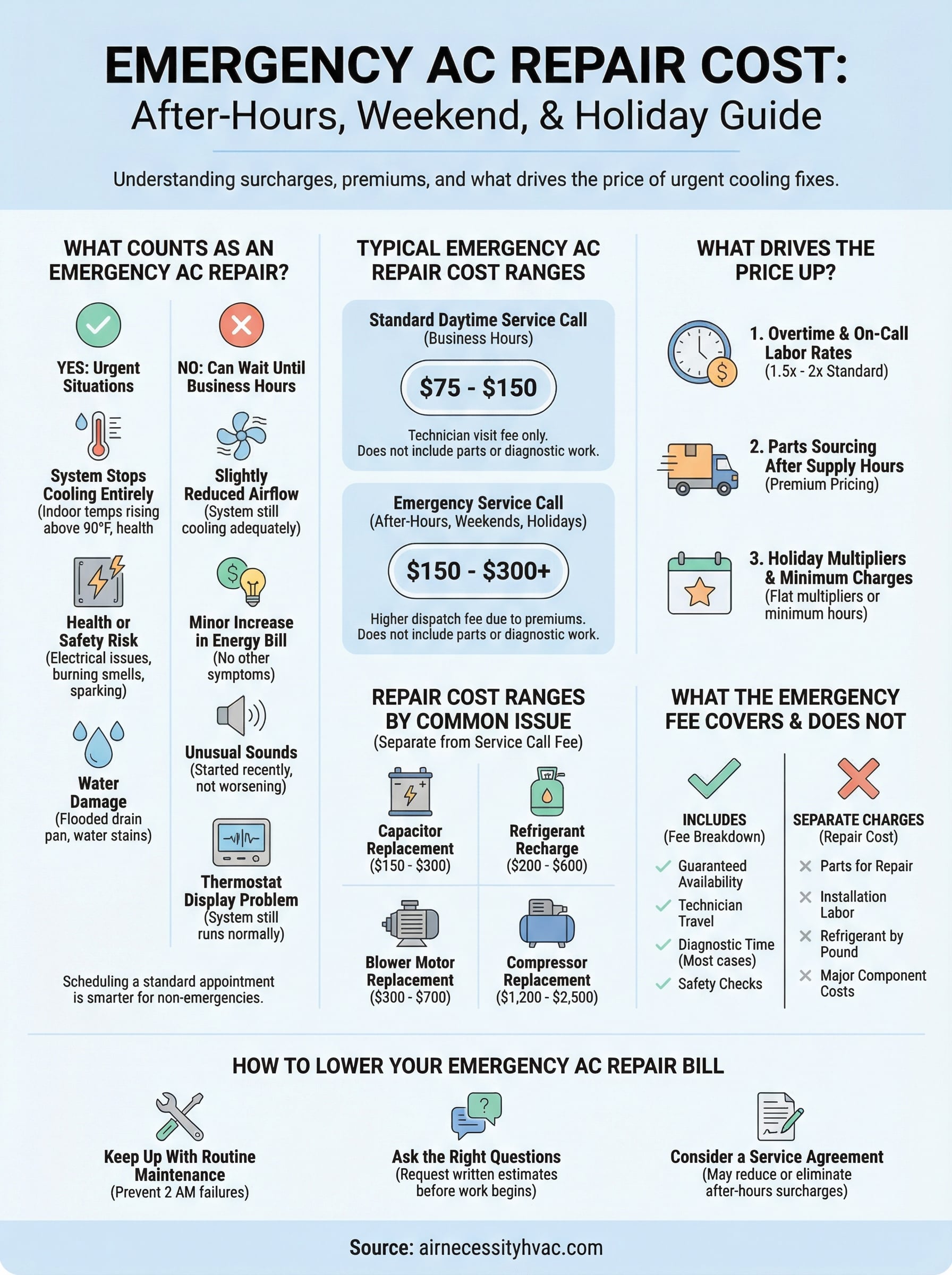
Not every AC problem justifies an after-hours call, and knowing the difference can save you hundreds of dollars. An emergency repair, in the eyes of most HVAC companies, is any service call where waiting until normal business hours poses a real risk to the people in your home or causes damage that will cost significantly more to fix later. That line is not always obvious, especially when you’re sweating through a Florida summer night and every option feels urgent.
When your system stops cooling entirely
If your AC is running but pushing warm or room-temperature air, that situation usually qualifies as an emergency. The same goes for a system that won’t turn on at all. In Southwest Florida, where outdoor temperatures can stay above 90 degrees well into the evening, a home without working AC heats up fast. A house that climbs to 95 degrees indoors is not a comfort complaint; it is a condition that puts elderly residents, young children, and pets at serious risk within hours.
In extreme heat, indoor temperatures can become dangerous for vulnerable people in a matter of hours, which is why a complete cooling failure warrants same-day attention rather than a scheduled appointment.
Refrigerant leaks that cause a full loss of cooling also fall into this category. Ice forming on the evaporator coil or refrigerant lines is another sign your system needs same-day attention. Letting that continue overnight can cause the compressor to fail, and a compressor replacement costs far more than a single emergency service call.
When the situation becomes a health or safety risk
Electrical issues tied to your AC unit push a repair firmly into emergency territory. If you notice burning smells, tripped breakers that keep resetting, or sparking anywhere near the unit, shut the system off and call immediately. These are not symptoms to monitor overnight; they are potential fire hazards.
Water damage is another category that moves fast. A flooded drain pan overflowing into your walls or ceiling causes structural damage quickly, and mold can develop within 24 to 48 hours in Florida’s humidity. If you see standing water around your air handler or new water stains appearing on the ceiling beneath your unit, that qualifies as urgent.
What typically does not qualify
Some AC problems are genuinely frustrating but not serious enough to justify a full emergency ac repair cost at 11 PM. These include:
- Slightly reduced airflow with the system still cooling adequately
- A minor increase in your energy bill without any other symptoms
- Unusual sounds that started recently but are not getting worse
- A thermostat display problem where the system itself still runs normally
If your home is cooling and no one inside faces a health risk, scheduling a standard appointment the next business day is almost always the smarter financial decision.
Typical emergency AC repair cost ranges
Knowing the general numbers before you call puts you in a much stronger position to evaluate quotes on the spot. A standard daytime service call in Southwest Florida typically runs between $75 and $150 just for the visit, before any diagnostic work or parts. An emergency service call after hours, on weekends, or over holidays usually starts at $150 and can reach $300 or more for the dispatch fee alone.
Standard vs. emergency service call fees
The service call fee covers getting a technician to your door, regardless of what they find once they arrive. Standard rates apply during normal business hours, typically Monday through Friday, 8 AM to 5 PM. Outside those windows, most HVAC companies charge an after-hours premium that runs between 1.5x and 2x the standard rate. On major holidays, some companies charge triple time.
The service call fee does not include the repair itself, so always ask for a complete written estimate before any work begins.
Repair cost ranges by common issue
Your total emergency ac repair cost depends heavily on what is actually broken. Below are typical price ranges for common repairs, separate from the emergency dispatch fee:
| Repair Type | Typical Cost Range |
|---|---|
| Capacitor replacement | $150 to $300 |
| Contactor replacement | $150 to $350 |
| Refrigerant recharge | $200 to $600 |
| Condensate drain clearing | $75 to $250 |
| Blower motor replacement | $300 to $700 |
| Compressor replacement | $1,200 to $2,500 |
Parts markups vary significantly between companies, and after-hours labor rates are higher than what you would pay for the exact same job during a scheduled weekday visit. Your final bill combines the emergency dispatch fee, the labor rate, and the cost of any parts required to complete the repair.
What drives the price up after hours and holidays
When you call at midnight on a Sunday, your emergency ac repair cost is higher than the same repair done on a Tuesday afternoon for a few concrete reasons. HVAC companies aren’t simply charging more because they can. Running an on-call operation involves real overhead that doesn’t exist during normal business hours, and those costs show up directly on your invoice.
Overtime and on-call labor rates
Technicians who respond to after-hours calls are typically paid overtime wages or on-call premiums, depending on how the company structures compensation. These rates often run 1.5 to 2 times the standard hourly rate, and that increase flows straight into what you pay. A repair that takes two hours on a Saturday evening at an elevated labor rate will cost noticeably more than the identical job completed on a Wednesday morning.
Calling in early spring, before the peak heat season, can sometimes mean lower overall costs even for urgent work, since demand on technicians is lower and scheduling is more flexible.
Some companies also factor in drive time at the elevated rate, not just the time spent on your equipment. Always ask whether the after-hours rate applies from the moment the technician leaves the shop or only from arrival at your home.
Parts sourcing after supply hours
Standard parts suppliers close at the end of the business day, which means technicians on after-hours calls pull from their truck stock at a premium or use emergency distributors that charge higher prices. Carrying and restocking that inventory has a cost companies build into after-hours pricing. If your repair requires a less common component, that markup can be substantial.
Holiday multipliers and minimum charges
Holiday rates work differently from standard overtime. Many companies apply a flat multiplier, often 2x to 3x, across all labor on designated holidays rather than standard time-and-a-half. Some also enforce minimum billable hours, meaning a 30-minute fix still bills as two full hours at the holiday rate.
What the emergency fee covers and what it does not
The emergency service fee is one of the most misunderstood line items on an HVAC invoice. Many homeowners assume the fee covers everything, while others assume it covers nothing beyond getting a technician in the driveway. Neither assumption is correct, and understanding exactly what you’re buying when you pay that surcharge helps you avoid surprises when the invoice arrives.
What the fee typically includes
When you pay an after-hours dispatch fee, you’re primarily paying for guaranteed availability and technician travel. That covers the on-call labor from the moment your technician heads out, the fuel and vehicle costs to reach your home, and the diagnostic time to identify the problem. Most companies include the initial assessment in the emergency rate, so you’re not paying a separate diagnostic charge on top of the after-hours premium.
Ask your HVAC company directly whether the emergency fee includes the diagnosis or if that’s billed separately, because the answer varies by company.
The fee also typically covers any required safety checks the technician performs before, during, and after the repair to confirm the system is running safely before they leave.
What you still pay separately
The emergency fee does not cover parts or the labor required to install them. Your total emergency ac repair cost is the dispatch fee plus the actual repair cost on top of it. Those are always separate charges.
Refrigerant is almost always billed by the pound as an additional line item, and it’s one of the more expensive components in a typical AC repair. If your system needs a compressor, blower motor, or any other major part, expect to see that itemized on your invoice well above and beyond whatever emergency surcharge you already paid.
How to lower your emergency AC repair bill
You can’t always prevent a breakdown, but a few practical steps can meaningfully reduce your total emergency ac repair cost without cutting corners on the actual repair. Acting before a crisis and asking the right questions during one both make a real difference in what ends up on your final invoice.
Keep up with routine maintenance
The most effective way to avoid a high emergency bill is to prevent the emergency entirely. Annual tune-ups catch small problems like a weakening capacitor or a clogged drain line before they turn into 2 AM failures. A maintenance visit during normal business hours costs a fraction of what the same repair runs at midnight on a Friday.
Regular maintenance is one of the few things you can do today that directly reduces the likelihood of paying emergency rates tomorrow.
Changing your air filter every 30 to 90 days also reduces strain on your system’s components, extending the life of parts that wear out faster under Florida’s heat and humidity.
Ask the right questions before you agree to anything
When you call for emergency service, request a complete written estimate before the technician starts any work. Confirm whether the after-hours fee includes the diagnostic charge or if that’s billed separately on top. Ask whether parts carry a flat rate or a markup above wholesale cost.
Requesting an itemized invoice upfront removes room for surprise line items when the job is done. You’re not being difficult by asking these questions; you’re treating a large unexpected expense the same way you would any other major home repair.
Consider a service agreement
Many HVAC companies offer annual service agreements that reduce or eliminate the after-hours surcharge for plan members. If your equipment is aging and emergency calls are a realistic possibility, the plan’s annual cost often pays for itself with a single after-hours visit. Ask about available plans before the technician wraps up and leaves your home.
Next steps
Emergency AC repair cost depends on timing, the specific failure, and how your HVAC company structures its after-hours pricing. The gap between a standard daytime repair and a midnight call on a holiday can be dramatic, but it doesn’t have to catch you off guard. Understanding what drives each charge before the crisis happens puts you in a much stronger position to evaluate a quote quickly and decide what makes sense for your situation.
Your best move right now is to schedule routine maintenance before your system fails, not after. A tune-up during normal business hours costs a fraction of what you’ll pay when the same problem shows up as a 2 AM emergency. If you’re already dealing with a cooling issue or want to get ahead of the Florida heat season, Air Necessity is ready to help. Contact our team for honest AC service in Southwest Florida and get a technician who gives you straight answers, not a sales pitch.